11 May 2011

Long live the legend Bob Marley!

Thanks for the songs of freedom. Peace, Bob Marley! You left us 30 years ago, but your spirit lives on. Long live the legend!


10. War. Bob took a speech from the Emperor of Ethiopia, Haille Selassie at the United Nations and made it a song that showed how racism was the cause of the many wars in Africa at the time.


9. Concrete Jungle. This song represented the struggle of the urban poor in the third world. Though the song refers to Arnett Gardens, a garrison in Jamaica, it could represent the poverty and tension found in any ghetto.


8. Redemption Song. This epic ballad represents the fight for freedom in the face of great adversity.


7. Africa Unite. During the 70s when Africa was ridding itself from colonialism, Bob made an anthem that would call for its countries to join forces in Pan-Africanism.


6. Revolution. Another song that calls for both a mental and physical revolution, wiping out wicked ideas from society.


5. Rat Race. While accusations of the CIA operating in Jamaica were common place, Bob addressed the issue in this song, “Rasta now work for no CIA.”


4. Belly Full. Bob goes into the poverty and drastic wealth inequality between the rich and poor in both Jamaica and this world, and the tension that they cause.


3. Get Up Stand Up. Though this song deals with the Rastafarian faith, it has become an anthem for sufferers everywhere.


2. Zimbabwe. This song represents the hope excitement of independent Africa and celebrates the fighters who fought against colonialism.


1. Ambush. In The Nigh. Bob was shot in 1976 and he addresses it in this song. He did not blame any political party despite accusations that the U.S. backed JLP was behind it, Bob did not blame any party but the climate of political nepotism and violence that lead to the attack.


Long live the spirit for freedom, justice, peace, unity, and love!

Fortress Denmark


Oh, fortress Denmark! 

Anyway, protectionist and nationalist tendencies can easily be predicted in the EU, where political-economic class alliances forged integration under conditions of uneven development. 

This right-wing government is 'alienating' Denmark from its old humane, progressive social system founded on the values of care and concern for others, solidarity, communitarianism, and egalitarianism. 

Resist and change!

05 May 2011

"Workers spend what they get; capitalists get what they spend."

Reference to the Speech of President Aquino at the 32nd National Conference of Employers


I like this speech of PNoy before the ECOP. The gist of his message to the employers reminds me of Keynes and the aphorism of Kalecki: "Workers spend what they get; capitalists get what they spend." 


I hope PNoy maintains this common sense in the art of creating a middle-income nation where economic growth leads to high income for the workers, increased earnings for the investors, and a larger tax base for the government!

03 May 2011

It's the Economy: The Threat to PNoy's Satisfaction Ratings

Reference to the GMA News Online report "SWS: Satisfaction with govt dips, but most still pleased"

If there's any that would gradually drag down PNoy's satisfaction rating, it's the economy. 


No doubt, PNoy has made very good political initiatives, including the appointment of progressives to important socio-political positions. However, the visioning and management of 'the economy' has remained the exclusive turf of the same monetarists-technocrats from Marcos to GMA (like Paderanga, Virata, Purisima, Sicat....).

01 May 2011

27 April 2011

Some Principles and Policies to Address Oil Price Hike and Inflation


We are in a very difficult situation! Oil prices largely contribute to inflation.

But I find Energy Secretary Jose Rene Almendras statements here more sensible than the Friedmanian conclusion of Deputy Presidential Spokeswoman Abigail Valte on price-control-leads-to-shortage. In a way, the legal action and monitoring mechanisms by DOE-DOJ are 'price control policies' that are good to combat 'administered pricing' of the greedy oil companies. But this is not enough!

The Galbraithian-Keynesian sense of Walden Bello should be seriously considered, addressing the needs for price stability and full employment towards growth, social welfare and social justice.

'Effective price controls' should be instituted with 'wage controls' to prevent imbalance between profits/investments and wages/incomes.

Fiscal policies must prioritize the people, workers and consumers through expenditures on job-creating programs and tax cuts (including of EVAT and in tolls).

Realign targeted funds of CCT in favor of 'universalization' of social welfare; government job guarantee schemes (a la Minsky's government-as-employer-of-
last-resort); and SME financing.

Use this crisis as an opportunity for socio-economic reforms (including disciplining of 'market forces'), as well as for environmental sustainability (alternatives to foreign oil-based production system).

PNoy administration must rediscover 'coordination' — in other words, team work — for this should involve a coordinated response from literally every department and agency of the government.

And yes, we also need good luck!

20 April 2011

"The Economics of Happiness"

I would like to see this documentary.... A movement for economic localization sounds appealing to me as well. It's a viable alternative development system. 


The Economics of Happiness - Official Trailer from The Economics of Happiness on Vimeo.


Watch the video clips and trailer here.

25 June 2007

Letter from Carlota Perez: 'The world is transformed by transforming it. And to transform anything one has to know how.'

Carlota Perez and Bonn Juego

I will be moving out of Tallinn in a few days' time. I will definitely miss the sights, sounds, smell, taste, and feel of Tallinn (I don't even wear my iPod these days, trying to be present most of the time and cherishing the things that I'll miss - those that have had become a part of my routine in the last 10 months). Tallinn has taught me a lot - academically, professionally, and personally. Thank you, thank you, thank you! The Tallinn experience has indeed been a good game, and will have tremendous impact on the pursuit of my personal legend.

As I pack up my things and tidy up my files for my return to the Philippines and later on settling in Denmark for another upcoming adventure, I came across this letter to me by Carlota Perez, author of the longtime Edward Elgar bestseller Technological Revolutions and Financial Capital: The Dynamics of Bubbles and Golden Ages (2002). To act as her teaching assistant on September 2006 was one of the best learning encounters I had in Tallinn. I have gotten to know closely a serious researcher, a dedicated teacher, and a truly lovely woman. I wish to share with you this thoughtful letter of Tita Carlota, instilling in me that idealism should be firmly grounded on wisdom and knowledge.
7 October 2006

Dear Bonn,

I read your letter now. It holds very similar views to your review and it is also very well written and argued. But of course you now know that I do not believe in those total transformations of the system.

We do not have any alternative theory to capitalism. Certainly Marx ended his critique of the system by saying that the workers should take over. That is not a theory of how to do it. Worse still, the foundations of that tenet are the socialization of the forces of production which he thought was occurring at the end of the second great surge. Many things have happened since then. Among other things his proposal was tried out and failed.

The Soviet experience showed how the workers (or the members of the party that says to represent them) become a privileged caste that uses power for its own aims and to control society but is not capable of setting up a social system of happiness for all. In my view, the best historical example of something really decent was the Swedish social democratic experience, but that (as much as the Soviet one and the Keynesian welfare state) was based on the characteristics of the mass production paradigm, which is now exhausted.

Thus we do not have a theory (or historical experiences) of how growth and social development can be achieved in a manner that is different from capitalism. We do have the experience of modifying capitalism as in the Keynesian welfare state to improve the lot of the great majority of society. I certainly believe in understanding the world in order to transform it for the better. My present understanding leads me to think that we can improve the present world with the present paradigm in ways that will make the lot of the majority of the people on the planet better.

It is not easy and it requires knowledge, knowledge and more knowledge; perseverance, perseverance and more perseverance; creativity, creativity and more creativity. It will not happen with anger, resentment, desperation, impatience, radical criticism or violence and destruction.

One cannot transform the world by "revealing" how awful it is and by wishing it were radically different. The world is transformed by transforming it. And to transform anything one has to know how.

I understand your impatience and I value the very serious efforts you are putting into studying and your acute sensitivity to injustice and inequality. I know, however, that personal experience is accumulated tacit knowledge that I cannot transmit to you. There is no other way than for you to learn for yourself through trial and error.

You can count on me in your journey.

Best wishes,
Carlota

One could just imagine how ecstatic I am receiving this reply from Carlota herself two years after I wrote it in the first instance only as a course requirement. I wrote my letter to her on September 2004 - the first time I read her book as a requirement in the course by J. Gabriel Palma when I was doing my International Masters in Regional Integration (IMRI) degree at the Asia-Europe Institute. Gabriel then required us to write a one-page 'think piece', a reflection of the assigned reading for each day. For that day, I chose to read her book and my 'think piece' style was in the form of a letter to the author. I read the letter in class. I read it again in Erik Reinert's course, as well as in Banji Oyelaran-Oyeyinka's and Carlo Pietrobelli's, professors who also required us to read her book. Here was the think piece I wrote:
20 September 2004

Dear Carlota Perez:

In your book Technological Revolutions and Financial Capital: The Dynamics of Bubbles and Golden Ages (2002) you have reinvented Schumpeter's concern on financial capital that greatly influences economic growth and technological transformation by interpreting how the changing relationship between technological advances and financial capital shapes the pattern of economic cycles. Avoiding the technological determinist trap, you have argued on the historical specificity of technological revolutions, which represents what you call 'techno-economic paradigms', and showing the interaction among technology, politics, society and culture leading to certain economic pattern.

Providing a historical and empirical account of the link between technology and finance, you have interpreted in detail the major historical breakthrough depicted in what you call 'techno-economic paradigms' that initiated the revolution: the industrial revolution (1771); the age of steam and railways (1829); the age of steel, electricity and heavy engineering (1875); the age of oil, the automobile and mass production (1908); and the age of information and telecommunications (1971). In this long-wave economic cycle phenomenon, you have focused on the crucial role played by social and institutional factors in first resisting the technological revolution, and then facilitating its unfolding potential.

An interesting point you have also made in your book is your distinction between production capital and financial capital not along the lines of the quantity of assets but on the motives and criteria of the agents with the purpose of creating wealth in a capitalist system. In the epilogue, you have recommended for the leadership of production capital (i.e., agents who generate new wealth by producing goods and services and whose objective is to accumulate greater and greater profit-making capacity) over financial capital (i.e., agents who already possess wealth and whose objective is to make money grow).

Far from being revolutionary (i.e., changing the social structure from the unjust domination of capital to a more humane one), you have concluded the need to (re)create institutions that are coherent for continued capital accumulation. While you may have aptly utilized historical-structural analysis in interpreting the dynamics of economics, you seem to fail in putting the social back in to your overall analysis. There is little doubt that the dynamics between technological revolution and financial capital throughout history, and which lead us to the current information society, have made major impacts on the relations between human beings and their environments across different social groups. However, it is in ways that largely enhance, and even recompose, existing relationships in a capitalist system. I am thus interested in asking 'how is the political economy of social relations shifting under the impact of market-led technological revolution?' What are the consequences of technological revolution, and its corresponding economic pattern, in the realm of corporate control and popular use?

I would like to think that the dynamics between technological revolution and financial capital entail both an institutional and ideological intervention toward the strengthening of market-driven social relations. Institutionally, market forces are managed through privatization (i.e., the sale of public assets to private investors), liberalization (i.e., opening up of restricted markets to competition), the reorientation of regulation (i.e., the securing of business interest), and corporatization (i.e., public sector organizations adopting corporate form of organization). In your book, you have questioned socio-political institutions without even questioning the political economy of capitalism in which the information revolution has brought rising inequalities of condition. The widening of social divisions is resonated in ownership of and access to technology and finance. The great unconsummated project of our time is not just to interpret reality but to change it.

Thank you,

BONN BRYAN T. JUEGO
IMRI Student (Philippines)

Carlota gave me a present - an original copy of her book which she personally used in her course at Tallinn University of Technology with the following dedication: 'To Bonn Juego - With good wishes for a brilliant future (30 Sept. 2006)'. Thanks for the inspiration, Tita. Thank you for being part of my nurturing. I'd definitely love your presence in my journey - your valuable accumulated tacit knowledge shall provide a firm grounding on my youthful idealism.

17 June 2007

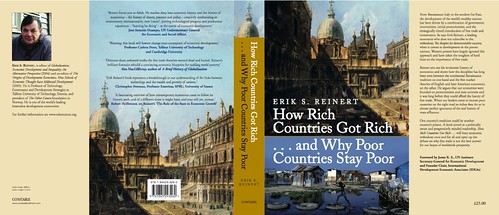
Erik Reinert (2007), 'How Rich Countries Got Rich ... and Why Poor Countries Stay Poor'

Erik Reinert (2007), 'How Rich Countries Got Rich ... and Why Poor Countries Stay Poor'


The new book of my supervisor, Erik S. Reinert, is now available at (online) bookstores: How Rich Countries Got Rich ... and Why Poor Countries Stay Poor (London: Constable, 2007). I am reproducing the details of the book below.


It is fascinating how this book has sparked both intense and intensive debates in economics, business, and the social sciences already, given that it was only published late April. Find out for yourself why Erik's book has elicited interesting debates as soon as it was published from
mainstream economists to heterodox economists to socialists to journalists to bloggers. (Here for Erik's reply to recent debates on his book.)


Do get one for you and for your institutes/organisations/networks/schools/libraries!


*****
HOW RICH COUNTRIES GOT RICH ... AND WHY POOR COUNTRIES STAY POOR
by Erik S. Reinert

----
AUTHOR

Erik S. Reinert is editor of Globalization, Economic Development and Inequality: An Alternative Perspective (2004) and co-editor of The Origins of Development Economics: How Schools of Economic Thought Have Addressed Development (2005). He is Professor of Technology Governance and Development Strategies at Tallinn University of Technology, Estonia, and president of The Other Canon foundation in Norway. He is one of the world’s leading heterodox development economists.

For further information see www.othercanon.org.

----
SYNOPSIS

From Renaissance Italy to the modern Far East, the development of the world’s wealthy nations has been driven by a combination of government intervention, initial protectionism, and the strategically timed introduction of free trade and investments. So says Erik Reinert, a leading economist who does not subscribe to the orthodoxy. Yet despite its demonstrable success, when it comes to development in the poorer nations, Western powers have largely ignored this approach and have taken the toughest of hard lines on the importance of free trade.

Reinert sets out his revisionist history of economics and shows how the discipline has long been torn between the continental Renaissance tradition on one hand and the free market theories of English and later American economics on the other. He argues that our economies were founded on protectionism and state activism and it was long before they could afford the luxury of free trade. When our leaders come to lecture poor countries on the right road to riches they do so in almost perfect ignorance of the real history of mass affluence.

One country’s medicine could be another country’s poison. A book aimed at a politically aware and progressively minded readership, How Rich Countries Got Rich . . . will bury economic orthodoxy once and for all and open up the debate on why free trade is not the best answer for our hopes of worldwide prosperity.

----
CONTENTS

Foreword by Jomo K.S., UN Assistant Secretary-General for Economic Development and Founder Chair of International Development Economics Associates (IDEAs)

Introduction

1 Discovering Types of Economic Theories
2 The Evolution of the Two Different Approaches
3 Emulation: How Rich Countries Got Rich
4 Globalization: the Arguments in Favour are also the Arguments Against
5 Globalization and Primitivization: How the Poor Get Even Poorer
6 Explaining Away Failure: Red Herrings at the End of History
7 Palliative Economics: Why the Millenium Goals are a Bad Idea
8 'Get the economic activities right', or, the Lost Art of Creating Middle-Income Countries

Appendices

I David Ricardo's Theory of Comparative Advantage in International Trade
II Two Different Ways of Understanding the Economic World and the Wealth and Poverty of Nations
III Frank Graham's Theory of Uneven Development
IV Two Ideal Types of Protectionism Compared
V Philipp von Hönigk's Nine Points on How to Emulate the Rich Countries (1684)
VI The Quality Index of Economic Activities

Notes
Bibliography
Index

(365 pages)

----
PRAISES

'Reinert forces you to think. He reaches deep into economic history and the history of economics - the history of theory, practice and policy - creatively synthesizing an evolutionary, institutionalist, new 'canon', putting technological progress and production experience - 'learning by doing' - at the centre of economic development. '
- Jose Antonio Ocampo, UN Undersecretary General for Economic and Social Affairs

'Warning: this book will forever change your conception of economic development.'
- Professor Carlota Perez, Tallinn University of Technology and Cambridge University

'Disinters those awkward truths the free trade theorists wanted dead and buried. Reinert's brilliant forensics rebuild a convincing economic blueprint for tackling world poverty.'
- Alex MacGillvray, author of A Brief History of Globalization

'Erik Reinert's book represents a breakthrough in our understanding of the links between technology and the wealth and poverty of nations.'
- Christopher Freeman, Professor Emeritus, SPRU, University of Sussex

'A fascinating overview of how contemporary economics came to follow its historic path, and of a different route it might have, and may still yet, pursue.'
- Robert Heilbroner, on Reinert's 'The Role of the State in Economic Growth'

22 April 2007

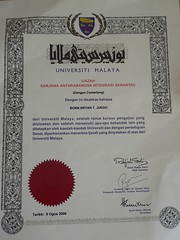
Dengan Cemerlang / With Distinction / Summa cum laude

UM Diploma

The European Union education system has finally recognised the International Masters degree (with distinction) conferred to me by the Asia-Europe Institute, University of Malaya. As such, I am now eligible to pursue doctoral studies in any European university.


After receiving the call in the office from the credentials evaluator of the academic recognition centre, I had a look at the diploma and transcript of records which I submitted to them for assessment. I glanced at the diploma in an offhand manner. Nothing special; and I thought it was even printed in an ordinary paper. What struck my attention more was that the paper was a bit crumpled due to the careless handling of the courier despite my friend Tina's (who I know to be very particular and caring) all caps notice to the courier in Malaysia when she mailed it to me here in Estonia: ‘PLS. DON'T FOLD. IMPORTANT DOCUMENTS INSIDE. THANK YOU!’


When I got back to the dorm, I thought of sending emails to my former professors - each of them has actually made an original contribution to their respective fields, making them to be among the world’s most distinguished scholars in the fields of development economics, regional integration, and political economy. I sent emails to them, expressing all over again my gratitude to the wonderful learning encounters I had with them when I was doing my MA, and also sharing with them the honour of receiving the ‘dengan cemerlang’, which is truly special to title-obsessed societies like Malaysia.


I never consider myself a great student. In fact, I had each and every mark in the University of the Philippines’ grading system encircled in my undergraduate classcards, from 1.0 to 1.75 to 2.25 to 3.0 to 4.0 to 5.0 to ‘inc’. The only grade I never had was ‘drp’ since I always said to myself then ‘tuloy ang laban’ (the fight shall continue) even though I could have handily opted for this grade when getting a 5.0 in Math 17 was already too imminent. I still keep all these undergraduate classcards in my ‘suitcase of memories’ (which is literally a suitcase where I have tried to keep memorable stuff since elementary and high school - and yes, including those cheesy love letters to my old crushes!). I was not in the top 10 of the graduating class in both elementary and high school. I had also my time in Row 4 (yes, that row for the slow, naughty pupils in the class!), kasama ng mga kakosa ko (with my fellow inmates), our groins always got pinched when I was in grade school. I did not even come from the top section in our high school when I graduated.


I received awards of recognition for leadership though for both the graduations in high school and college - as the highest boy scout leader in the former and as member of the student council and leader of several student organisations in the latter (I was even nominated to the UP Diliman Gawad Chanselor Para sa Pinakamahusay na Lider Estudyante [UP Chancellor's Award for Outstanding Leader] which, I was told, I could have won had it not for the ‘inc’ I had during that semester – long story). But then I do not consider myself to be academically excellent. During the time he was president of UP, my former professor, Francisco Nemenzo, even described me as ‘flippant at times’ in one of the ‘handwritten’ recommendation/reference forms he filled out for me. (Yes, I've kept that recommendation letter in my suitcase)!


In other words, getting a ‘summa cum laude’ for my International Master’s degree feels too good to be true, if not funny enough. Until I received replies from my former professors.... And these lines flattered me but saddened me as well (especially when this wonderful and passionate teacher said his teaching stint is now over):

Dear Bonn,

…[T]he honorific "dengan cemerlang" is entirely merited - whatever...you went through in...Malaysia could never take away from the fact, pure and simple, that you are an outstanding scholar with a tremendous passion for knowledge. You deserve everything, Bonn!

Though you are in my heart for many reasons - not least your high-level monkeying around - I also realise that you were my last great protege as a student and, if I may say so, the best of the bunch. Sometimes I pass a few moments thinking of those whom I have taught - [IP, LC, AN, DK, RR], and the rest. They're all in the academic world, ploughing their furrow, teaching a new generation, writing their findings. But you were the best and you will go furthest in pushing our understanding of critical political economy. I feel my teaching stint is done ... time for other things now.


Thanks for the very kind words, Professor, especially for the reminder that what has been awarded to me is full of meaning. I'll try to carry on. Now I have understood more than ever why my mother was disappointed to learn that I did not attend the convocation to receive this distinction. I have once again discovered how the mundane can be extraordinarily special, how one thing can contain everything, and how the commonplace can be deciphered to understand its beautiful mystery.


I had a sentimental glance at the diploma, embraced it close to my heart thanking those who have blessed, helped, and motivated me, including the Malaysian people, especially the workers, whose sweat has cultivated and fertilised me with so much blessings. And I said to myself that I will never look at that crumpled paper indifferently again! It is a token readily retrievable from memory to keep me inspired especially during times of doubt when a dormant optimism needs to be awakened. Indeed, like any other objects, that piece of crumpled paper is inanimate. It is I who shall give life to it.


Well-meaning friends and family often ask me: Why Malaysia when I could get to Singapore? Why Estonia when I could get to the UK or the US? I thank Robert Frost for providing the answer:

Two roads diverged in a wood, and I –
I took the one less travelled by,
And that has made all the difference.


P.S. The other day I received another beautiful inspiring letter from my first ever boss and former professor, who is well-regarded as a serious scholar with multi-awarded research and who recommended me to do my MA at the Asia-Europe Institute.

Dear Bonn,

It looks like you're living a charmed and charming life out there getting to places we can only imagine and meeting all kinds of interesting and important people. You also work with a very solid core of scholars who are on the cutting edges of unorthodox but compellingly relevant academic and policy approaches to the social sciences.


Indeed, we grow and progress in life remembering what motivates and inspires us, and forgetting the old things of no value that have once stolen our dreams. This, I – we – must take to heart and keep in mind. This is how to play a good game dengan cemerlang, with distinction.

08 April 2007

A Meaningful Easter in this Wonderland

Wonderland

During the Holy Week I've been writing to friends that I felt the Holy Week more when I was in the predominantly Muslim country of Malaysia a couple of years ago than here in the predominantly Lutheran Estonia. But after some heartfelt encounters I had with an old working woman in the laundry on Holy Wednesday and Maundy Thursday, I could say I have not only 'felt' the spirit of Lent here, I have soulfully 'experienced' it. This heartwarming experience I hold between me and my God. I go BAGETS for the Holy Week; thanks to a reminder from Fr. Jerry Orbos, whose reflective message I also forwarded to family and friends for Lent: Balik Panginoon, Alis Galit, Gawa Mabuti, Express your love, Tanggal Bisyo, Sacrifice, Smile, Secret. I thus keep these things a secret, something between me and my Master. As Fr. Jerry wrote:

S-Secret: If you want to experience real joy, do all of the above in secret. Let it be something just between you and your God, and you’ll experience a joy which the world cannot give or take away. Come to think of it, maybe this is the reason I started this column with a note about being a secretary—a reminder to keep our Lenten project of transformation and communication a secret.
As I am not familiar with the changes in the schedule the church here made in observance of the Holy Week, I thought of dropping by the church yesterday to see whether an English mass would be celebrated. There I found myself as the only member of the faithful, aside from the two guys fixing some decorations in the altar. I knelt down and stayed awhile for some quiet moments. I then proceeded to the bookstore where I found myself holding Lewis Carroll's classic Alice's Adventures in Wonderland & Through the Looking-Glass (1871). I bought it, as well as Jorge Luis Borges' The Mirror of Ink (1933) -- both I intend to read when I leave Tallinn and travel around Europe in the next few weeks.

I am a child again. I have started reading
Alice in Wonderland this Easter Sunday. I am enjoying it. The book has both pictures and conversations! As Alice said to her sister at the beginning of the book: 'and what is the use of a book without pictures or conversation?' This line immediately hit me, and made me smile, being reminded of those moments when I used to candidly say to my bookworm friends that I don't read novels because I find them too long and all letters! But then a friend once teased me during one of our trips to Puerto Galera when she caught me relaxing in my cottage holding a heavy read, and she said to me: 'Why are you reading Marx on the beach?!'

Thus far, I have now encountered several characters in Alice's Wonderland. The first was the White Rabbit with pink eyes (whose figure is also the illustration in Chapter One) which ran close by Alice uttering, 'Oh dear! Oh dear! I shall be too late!', and taking a watch out of its waistcoat-pocket. To her burning curiosity seeing for the first time a rabbit with a waistcoat-pocket and a watch, Alice followed the White Rabbit and there she found herself down the rabbit-hole to experience the adventures in wonderland. (Interestingly, since this classic work the image of a 'white rabbit' in many folklore has been related to a sign of a new adventure and even good luck.)

Upon searching for e-cards to send to friends this morning I have noticed that the images and symbols that are associated with Easter include eggs, flowers, ducks or hens, rabbits or bunnies, and crucifix or the risen Lord. I am reminded of the Philippines where most people observe the Lent in the sorrowful passion of Christ, and hence the images of the cross and the performance of various penance. In other countries, however, Lent is observed with symbols of eggs, flowers and bunnies, which may appear to some to be only about a celebration of the glorious moment of Easter without the sorrowful mystery of the season. I do not want to go deeper into a discussion of this seeming difference in observance of Lent in various places and its implications for peoples' worldviews.

Cultural symbols signify a great deal about the way of life and thinking of people in a given territory. But I must also hasten to say: cultural symbols are not only bounded in space, or in a given territory, but also in time. It is sad to think that important cultural symbols that can be said to comprise a 'good life' only take the spotlight during occasional specific time frames (e.g., the images of rabbit and the risen Lord are only prominent during Lent). Such is the tragic case in my dear country. Rather than being truly integrated into the lifeworld of people, the symbols of Easter -- which all point to the virtues of faith, hope, and love -- will be corrupted by the vicious curse of the materiality of the political economy of poverty and plutocracy. The reason ain't mystery, it's history: people's way of living, or their happiness, is profoundly link to the wider material and social world.

After reading the first chapters of Alice's Wonderland, I flicked through the last pages of the book and there I found this beautiful and timely letter from Charles Lutwidge Dodgson, aka Lewis Carroll, which I am reproducing here. I imagine this letter to have been written to me, both as a child of my dear mother and as a child of the struggle for change. Too, I wish I could have written these lines to the children of the world, especially the hopeful children in the Land of the Morning, the Pearl of the Orient, my dear country, Pilipinas.
Sadly, like many other classic works, Carroll's story endures but the impact of its message is obscured in the history of human relations.
Written in the spring exactly 131 years ago, we may cry a la Alice, becoming 'Curiouser and curiouser' and later on find ourselves swimming through the pool of tears we have had wept in the course of our adventures in this wonderland we call our world. But then again, it is the challenges and adventures, and our reflection upon our past, present, and future, that make life worth living.
An Easter Greeting
TO EVERY CHILD WHO LOVES
Alice


DEAR CHILD -
Please to fancy, if you can, that you are reading a real letter, from a real friend whom you have seen, and whose voice you can seem to yourself to hear, wishing you, as I do now with all my heart, a happy Easter.

Do you know that delicious dreamy feeling, when one first wakes on a summer morning, with the twitter of birds in the air, and the fresh breeze coming in at the open window — when, lying lazily with eyes half-shut, one sees as in a dream green boughs waving, or waters rippling in a golden light? It is a pleasure very near to sadness, bringing tears to one’s eyes like a beautiful picture or poem. And is not that a Mother’s gentle hand that undraws your curtains, and a Mother’s sweet voice that summons you to rise? To rise and forget, in the bright sunlight, the ugly dreams that frightened you so when all was dark — to rise and enjoy another happy day, first kneeling to thank that unseen Friend who sends you the beautiful sun?


Are these strange words from a writer of such tales as Alice? And is this a strange letter to find in a book of nonsense? It may be so. Some perhaps may blame me for thus mixing together things grave and gay; others may smile and think it odd that any one should speak of solemn things at all, except in Church and on a Sunday: but I think — nay, I am sure — that some children will read this gently and lovingly, and in the spirit in which I have written it.


For I do not believe God means us thus to divide life into two halves — to wear a grave face on Sunday, and to think it out-of-place to even so much as to mention Him on a week-day. Do you think He cares to see only kneeling figures and to hear only tones of prayer — and that He does not also love to see the lambs leaping in the sunlight, and to hear the merry voices of the children, as they roll among the hay? Surely their innocent laughter is as sweet in His ears as the grandest anthem that ever rolled up from the 'dim religious light' of some solemn cathedral?


And if I have written anything to add to those stores of innocent and healthy amusement that are laid up in books for the children I love so well, it is surely something I may hope to look back upon without shame and sorrow (as how much of life must then be recalled!) when my turn comes to walk through the valley of shadows.

This Easter sun will rise on you, dear child, feeling your 'life in every limb', and eager to rush out into the fresh morning air — and many an Easter-day will come and go, before it finds you feeble and grey-headed, creeping wearily out to bask once more in the sunlight — but it is good, even now, to think sometimes of that great morning when the 'Sun of righteousness shall arise with healing in his wings'.

Surely your gladness need not be the less for the thought that you will one day see a brighter dawn than this — when lovelier sights will meet your eyes than any waving trees or rippling waters — when angel-hands shall undraw your curtains, and sweeter tones than ever loving Mother breathed shall wake you to a new and glorious day — and when all the sadness, and the sin, that darkened life on this little earth, shall be forgotten like the dreams of a night that is past!


Your affectionate friend,

LEWIS CARROLL
Easter 1876


I could so well relate to this letter. I have discovered the child in me again. This, especially, I personally dearly miss:

Do you know that delicious dreamy feeling, when one first wakes on a summer morning, with the twitter of birds in the air, and the fresh breeze coming in at the open window—when, lying lazily with eyes half-shut, one sees as in a dream green boughs waving, or waters rippling in a golden light? It is a pleasure very near to sadness, bringing tears to one’s eyes like a beautiful picture or poem. And is not that a Mother’s gentle hand that undraws your curtains, and a Mother’s sweet voice that summons you to rise? To rise and forget, in the bright sunlight, the ugly dreams that frightened you so when all was dark — to rise and enjoy another happy day, first kneeling to thank that unseen Friend who sends you the beautiful sun?

And this, particularly,
for all the children of the 'Sun of righteousness', I earnestly pray:
...[B]ut it is good, even now, to think sometimes of that great morning when the 'Sun of righteousness shall arise with healing in his wings'.

Surely your gladness need not be the less for the thought that you will one day see a brighter dawn than this — when lovelier sights will meet your eyes than any waving trees or rippling waters — when angel-hands shall undraw your curtains, and sweeter tones than ever loving Mother breathed shall wake you to a new and glorious day — and when all the sadness, and the sin, that darkened life on this little earth, shall be forgotten like the dreams of a night that is past!

Wishing you and your families all the blessings Easter brings. May we all keep the Easter virtues of faith, hope, and love alive in our hearts. And may we not forget that the greatest of them all is love. Let the invincible love in us conquer the alienating curse of wickedness, anger, hatred, and fear haunting many of us.

Have a meaningful Easter down the rabbit-hole in our adventures for the good life in this wonderland!

04 March 2007

A Practicum on Racism (Apologies for Expletives)


Within a 15-hour period I have had experienced two quite different racist affronts. Last night and this morning. In the streets of Europe. Neither subtle nor hidden. Both received doubly just responses from me. The hatred of these three pale, smelly, filthy, drunkard, aggressive skinhead hooligans backfired on them -- receiving sharp blows they deserve from a force of justice. Educated activists like me always carry with us the swords of justice, ready to avenge whatever insults and offset injustice in all its forms.

Last night at around half past seven in Viru Keskus (perhaps the most popular mall in Tallinn). I met with MQ, a new Filipino resident in Estonia with years of international experience in the shipping industry. On our way out of the mall to have some drink in the Old Town, I sensed somebody passing through my back and uttering some Chinese sounding prattles 'ching-chong-chang'.
Nagpantig ang tainga ko (I didn't like what I heard)! It irritated me and instantly reminded me of the racist insult Shaquille O'Neal made in a press conference towards Yao Ming over a couple of years ago. I said 'Kupal 'to ah!' (Such a smegma!); and then I looked back and saw this six-foot-something youngster looking drunk, face gone red, wearing a bonnet on his way up already on the stairs. Our eyes met, I gave him a tiger look and I said to his face 'Hoy, kupal!' and threw a dirty finger at him. He did not react.

This morning at around half past eight. I was with MQ again. We didn't have any plans to go wherever -- just to have a walk. But we happened to pass through this very controversial, highly sensitive monument which has long been a source of serious conflict between the two social groups in Estonia -- the local Estonians and the Russian-speaking community. The monument, often referred to as 'Bronze Soldier', depicts a bronze figure of a lone Soviet soldier with the hammer and sickle emblem behind its head. It was erected in 1947 and said to be in memory of the soldiers who died fighting for the USSR against the Nazis. For some though, this 'soldier-liberator' recognition of the monument defies the real history of Estonian independence because it actually is a tricky relict perpetuating Russia's historical denial. It becomes even more contested because it stands right at the very heart of the city of Tallinn. The issue holds resemblance to the revival of Japan's denial to admit the excesses of its military occupation during World War II with the recent controversy provoked by the categorical pronouncement of Japanese Prime Minister Shinzo Abe of the absence of proof to warrant Japan's guilt on sex slavery. Interestingly, if not contemptuously, I remember reading in the news that people from both the opposing camps even sent their respective appeals to US President George W. Bush to intervene either for the removal or retention, depending on whose interest, of the monument during his state visit in Estonia on November 2006 (To my mind, what a brazen sell-out of sovereignty!). Such implies the intensity and complexity of this convoluted issue that involves questions of history, ethnicity, legality, politics, and even psychology.

Going back to the story....When we reached the monument premises, MQ took pictures of the monument with some colourful flowers on the ground. There were two other people in the area who we later learned to be mediapeople from the Latvian national television, taking videos of the monument. While we were chatting with the media reporter I noticed three girls who drew closer to the monument but then left the place immediately. After a few minutes, MQ and I decided to go on with our walk around the Old Town. Just about a few meters away from the monument there were two guys walking opposite our lane. And suddenly one guy did a side step towards our path and then spat in front of us! I then reacted and said
'gago 'to ah'! (Such a hooligan!) At first I thought it was not intentional and then I looked back at the two with a frown on my face and with angry eyes. I made eye contact with the spitting guy and he said 'fuck off'! I fired back at him with a louder shout than he did, 'fuck off'! I then threw a dirty finger at him. Both of them proceeded their way and didn't react on my cursing hand gesture. MQ and I continued our walk to the intersection and while we were waiting for our turn at the traffic light we looked back at the two racist nutheads and we saw one of them splattering liquids from the plastic bags they were carrying onto the monument and the flowers (We suspect it was urine). The spitting guy confronted the woman reporter from Latvia with whom MQ and I had a nice chat. While the spitting guy was barking at the Latvian reporter his left hand was trying to block the video camera, which the reporter's cameraman switched on to capture this berserk spitting guy, who I also saw, to have splashed some liquid on the camera. A very sad scene indeed, not only of racism but, based on my conception, of an excessive nationalist sentiment.

While we were walking through the Old Town and turned our backs on the ugly sight of fascist bullying going on a few meters from us, I told MQ how disgusted I am. A father that he is with a military training as well, MQ had been sober all throughout our bad experience from lost souls. MQ said to me that he understands them. I, too, understand them.

The first incident last night with the 'ching-chong-chang' youngster I could easily bear. But the hooligans who spat on our path warrant the painful consequence of their uncivilised acts! I feel I do not deserve such treatment -- and nobody has the right and the arrogance to demean any human being in this world. In my half a year residence in Estonia I have paid my dues to this society. I have had contributed in my own little ways to the development of its education system and to policy advice for its economic development. I pay taxes to the government, give donations to the church, and I even enrolled my bank account to this system in which a certain amount of my purchase goes to charity every time I use my ATM. How I wish I am doing these endeavours to my country, where my home is and my heart truly belongs; and to the millions of my fellow citizens, whose blood and sweat gave me the privilege of a wonderful education from the premier university. Some may think I had stooped down to the levels of these hooligans so young to waste their lives finding meaning in the meaningless pursuit of racism and fascism. But I feel I have given justice to myself, and been able to assert justice over unjust bullying. When we let bullies do their way, they will always contrive to do their way. Justice is there to offset any injustice.


In my first few weeks here in Estonia I have felt how difficult it is for activists like me to live in this young republic. Almost all of the issues of concern of activists and NGO workers are alive here: a neo-liberal economy, a government very supportive of the US coalition of the killing, xenophobia, homophobia, ecological degradation, racism, trafficking of women, increasing HIV-AIDS incidence, petty crimes, etc. True that these issues can be found in almost all societies in this world. But for such a small country, for such a developing economy, for such a young republic like Estonia the intensity and scope of these social (i.e., political, economic, cultural, ecological, gender) issues and ills are extremely alarming for its developmental trajectory as a polity, as an economy, and as a society. For a few years now, before I venture into any challenges I am about to face in life, I say to myself: 'Don't go there if your heart is not strong'.

Do not get me wrong that I do not like this country. I consider the incidents I encountered as isolated cases. A traveller always has to satisfy two thirsts which one cannot long neglect without drying up: admiring and loving. At the end of the day, despite this mad experience of an intolerable reality, I could still feel that happiness, love, and justice are still intact in myself, rediscovering the memory of the beauty of Estonia and its people that has never left me.

The more I experience human-relations-among-different-races-turning-out-badly the more I get to know myself that my mind and my heart could really not tolerate injustice. The advocacies I believe in are not only for a living, they are part of me. Three incidents abroad in the past come to mind. First, in Malaysia I almost hit a drunk man in his face when he cursed my friend in a Chinese language, a really foul cuss word I understood which my friend did not. Thanks and no thanks to my classmates in Malaysia who taught me the cuss words in Chinese and Bahasa Melayu. But much thanks to my classmate who timely pulled my arm to prevent the Manny Pacquiao super punch to hit him and brought me back to sober senses. Second, in Singapore I reacted when this vendor at Lucky Plaza said to me and to my friend: 'You Filipinos you just ask and ask, but you don't buy....' I did not let him got away with it and I answered back, 'Don't be a racist and say Filipinos are this and that'! Third, in Kuala Lumpur's red light district of Bukit Bintang with my international classmates, a pimp was offering us 'young girl, young girl'. I first confronted him and said to him: 'That's disgusting'! He kept on repeating: 'What? What? What?' I also kept on saying: 'That's disgusting'! And then, I said to him, 'We work for a human rights organisation'! He eventually backed off and left the place. Saying 'That's disgusting' has always been my line every time I've been confronted by pimps. I have also done this in Bangkok and in Tallinn.

I am quite versed in the issues related to racism. But racism is stranger in personal experience than in texts. The 'personal is political' dictum of the feminists also applies to the issue of racism. That is to say, one can only fully understand the politics of racism through personal experience. Most of the time racism does not know the victim's class background, academic knowledge, economic status, and professional experience; it only knows colour and physical attributes. Poverty exacerbates it. The history of colonialism, manifested in both material and extra-material aspects, deepens and perpetuates it, letting this monster celebrate its orgies in haunting generations by generations into a world replete with people doomed to die as if they have not lived. I wish that rather than setting up hatred against racist acts done to anyone, the sensibility for meaningful coexistence can strike any human being in the face! Education is key to stopping this vicious assault to humanity, especially in the wisdom offered by the fields of history, anthropology, psychology, geography, sociology, philosophy, politics, arts and humanities.

I cannot say that my acts have instantaneously succeeded in offseting injustice with justice. After all, the spitting hooligans proceeded to harass the Latvian mediapeople even after I showed them I could not be swayed by their bullying pretence. I could only hope that my not being silent at those morally intolerable moments of exchanges with the 'ching-chong-chang' youngster and the spitting hooligans have made them felt the jolt utterly necessary to awaken their souls and realise the indomitable humanity long been slumbering in the nightmare of the dead generations. To paraphrase Marx, the history of all the dead generations weighs like a nightmare in the brains, hearts, and souls of the living and the generations yet to come. I could only hope that one day the nightmare of the dead generations of Hitler, Stalin, Mao, and all the other tyrants, with their shared worldview of unequal humanity that led to our history of people striving for superiority rather than equality, comes to an end as soon as possible. We all have to work together so as the entire humanity be soon reconciled to what we have always been -- peaceful, loving, and beautiful human beings.

I let these lines from the philosopher Albert Camus in his essay 'Return to Tipasa'
(1950) speak for me as a way of concluding this reflective post, lines which are even more apt as a reminder to our time not only in the context of Europe:

'For there is merely bad luck in not being loved; there is misfortune in not loving. All of us, today, are dying of this misfortune. For violence and hatred dry up the heart itself; the long fight for justice exhausts the love that nevertheless gave birth to it. In the clamour in which we live, love is impossible and justice does not suffice. This is why Europe hates daylight and is only able to set injustice up against injustice. But in order to keep justice from shrivelling up like a beautiful orange fruit containing nothing but a bitter, dry pulp, I discovered once more...that one must keep intact in oneself a freshness, a cool well-spring of joy, love the day that escapes injustice, and return to combat having won that light....In the middle of winter, I at last discovered that there was in me an invincible summer'.

To be for justice. To be for hope. To be for love.